100
2026.01.28

Three ways to walk through the forest of life: the image of the Russian Trinity
A topic related to the musical organization of the trochion is proposed for discussion, a unique style of early Russian liturgical polyphony, linear in nature with a quarter–second vertical. The three-line is a written tradition and has not been preserved in liturgical practice. A three-line chant is written in the canonical liturgical text, has a beginning and an end, that is, it exists in a musical space. It always begins with the unison of the three voices of the male choir, and ends with a chord of three sounds. The three lines are based on the traveling chant, which is a transformed and expanded version of the more ancient znamenny chant. The names of the voices written out in the manuscripts, Path, Bottom and Top, refer us to images of space, travel, where one must follow a certain route along a path-road-path through life, which can be represented as forests, copses interspersed with fields ("to live a life is not to cross a field"). The path can be comfortable and straight, or it can be wet, crooked, and there are trees, puddles, rocks, overgrown bushes, and a fallen tree trunk along the way. You need to avoid them without losing your way to reach your destination. The main voice of the three-line Path is wrapped around the top and bottom of its two variants – the Top and Bottom, diverging from the initial unison. The triune PATH is being rebuilt, but all the voices are variants of the same path. The texture of the three–line vocalization is a seemingly random, but at the same time precisely fixed and canonical movement of a polyphonic warehouse for this tradition. The movement is interrupted only in specially designated places, marked by the methods adopted here: the E sign, the remarks "repair", "capture", etc. The path is "hidden" in the middle of the score behind the melodic figures of the extreme voices, which is in line with the medieval guild approach to professional knowledge and at the same time corresponds to the philosophical religious views of the late Russian Middle Ages.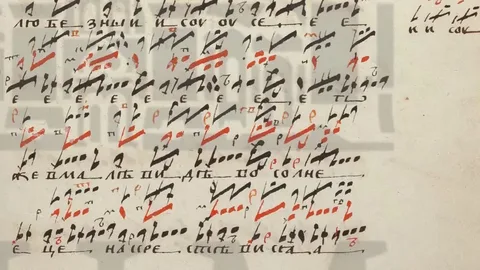
Jesus has risen from the grave.