About the project
The emblem of the project is the seven-pointed star of the heptatonic scale in the most ancient treatise on music (CBS 1766), written in Sumero-Akkadian cuneiform script in the middle of the second millennium. In the very fact of incompleteness, it conveys the elusiveness of the fullness of knowledge and the eternal desire to achieve and retain it in the cycle of time and historical processes.
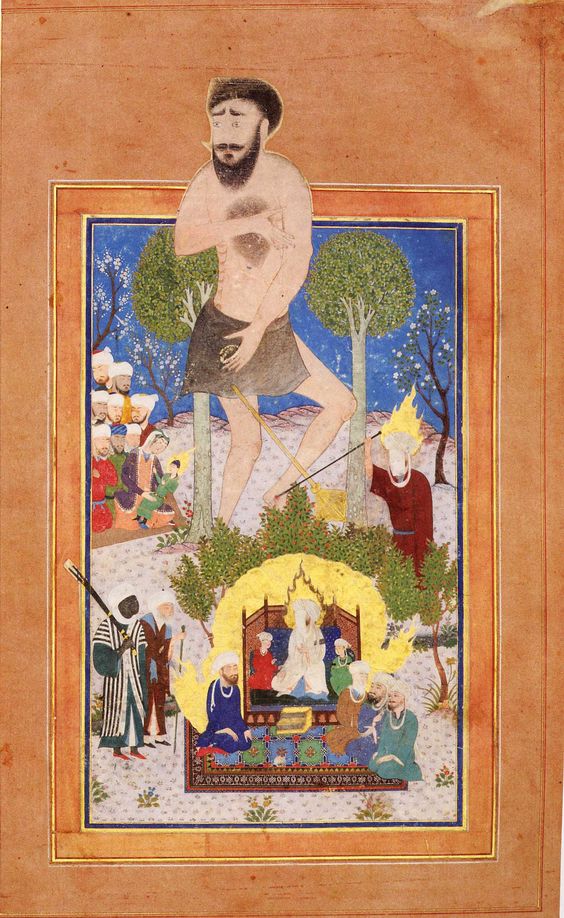
West Asia, the region of the most ancient civilizations, has become a centrifugal force for the spread of knowledge and the cradle of music theory for the cultures of the Abrahamic circle. The vivid visualization of the concept of the Abrahamic traditions in the Qiṣaṣ al-Anbīyah manuscript ("History of the Prophets", XV century, Baghdad or Tabriz) conveys the unity of the images of Muhammad, Moses and Jesus.
The Prophet Muhammad sits in the foreground with his family and Muezzin Bilal ibn Rabah; in the background, the prophet Moses strikes the giant Og ("Uj") with his staff, sweeping away the Antediluvian past and its characteristic thinking, laws, aesthetic preferences — everything is denied, overgrown with new meanings. The figures of Mary and Jesus in the third plan recall their veneration in all three religions.
Being distinguished by his height and action against the background of the motionless prophets, Moses symbolizes the bonds of the traditions of the Abrahamic circle, their common root in all cultural diversity.
In music, the concept of "Abrahamic traditions" is not limited to cult or secular genres and forms. It points to systematically emerging ideas about ethics and law as the foundations governing all spheres of life. Music making is the result of a person's most sensitive response to the impulses of the surrounding world, where ethical and legal norms play a fundamental role in justifying prohibitions and preferences. Music, understood in the cultural system as a way of making sense, presents a variety of forms of music making that distinguish some peoples from others and unite them into large communities. Our goal is to understand the foundations of diversity and unity in music as a unique language capable of overcoming boundaries and barriers of misunderstanding.